Master the Basic Knife Cuts: Dice, Julienne, and Chiffonade
Knife cuts form the foundation of efficient food preparation. Whether preparing a quick weeknight stir-fry or a detailed dinner party dish, the ability to cut ingredients into consistent shapes influences both cooking speed and the final presentation. Three fundamental cuts—dice, julienne, and chiffonade—appear repeatedly in recipes across many culinary traditions. Understanding their techniques allows a cook to approach recipes with more confidence and control.
Each cut serves a specific purpose. Dice creates cubes of varying sizes suitable for soups, stews, or sauces. Julienne produces thin, uniform strips that cook evenly and add visual structure to salads and stir-fries. Chiffonade transforms leafy herbs and greens into delicate ribbons that distribute flavor without overwhelming texture. Practicing these cuts regularly can contribute to smoother workflow and more consistent results in the kitchen.
Before exploring each cut in detail, it is helpful to consider the tools and habits that support safe, precise cutting. A stable cutting board, a sharp knife, and a consistent hand position create the conditions for good technique. With these basics in place, the methods for dicing, julienning, and chiffonading become easier to learn and maintain.
Foundation: Selecting the Right Knife and Setting Up the Workspace
The choice of knife influences how readily a cut can be performed. For most vegetable and herb cuts, an eight- or ten-inch chef’s knife offers the best balance of blade length and control. The curved blade allows a rocking motion that keeps the knife tip in contact with the board, reducing lifting and promoting consistent slices. Using a knife that feels comfortable in the hand and is kept sharp reduces the amount of force needed, which in turn lowers the risk of slipping.
A cutting board that does not slide is equally important. Placing a damp paper towel or a non-slip mat underneath the board prevents movement during cutting. The board itself should be large enough to accommodate the ingredient and the cut pieces without overcrowding. Keeping a clean board also prevents cross-contamination and makes it easier to see the lines and angles needed for uniform cuts.
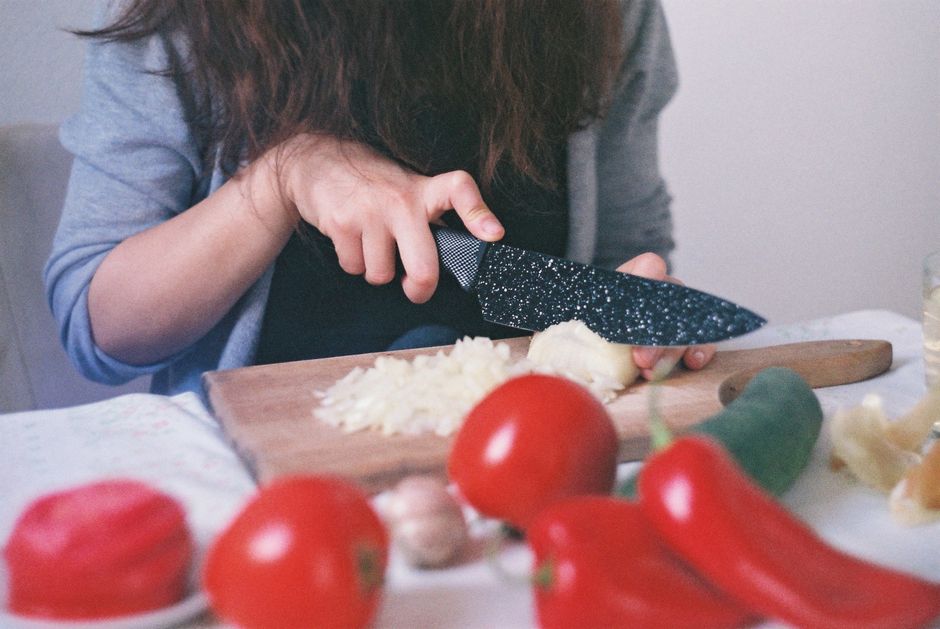
Hand positioning plays a neglected role in precision cutting. The guiding hand forms a claw shape, with fingertips tucked under and knuckles leading the way. This grip protects the fingertips and allows the blade to slide against the knuckles as a guide. The knife hand holds the handle firmly but not tensely, with the thumb and index finger pinching the blade just above the handle for added stability. Practicing this grip during slower cuts can help it become second nature over time.
The Dice Cut: From Large Cubes to Fine Brunoise
Dicing involves cutting an ingredient into cubes of equal size. The size determines the name: large dice (about 3/4 inch), medium dice (1/2 inch), small dice (1/4 inch), and brunoise (1/8 inch). For many home cooks, beginning with a medium dice on onions or carrots provides a good starting point. The process typically starts by squaring off the ingredient to create flat surfaces that allow stable stacking.
To dice an onion, first cut off the stem end, leaving the root intact. Peel the onion and cut it in half lengthwise through the root. Place one half flat on the board and make horizontal cuts toward the root, stopping just before the root end to hold the layers together. Then make vertical cuts parallel to the root, again leaving the root uncut. Finally, slice perpendicular to the board to produce cubes. The root end can be trimmed off after cutting. This method produces relatively uniform pieces without extra effort.
For carrots, it helps to first cut the carrot into sections of equal length, then square each section by trimming off the rounded sides. Stack the squared pieces and cut them into planks of the desired thickness. Stack the planks and cut into sticks, then cut across to form cubes. While the process may seem slow at first, consistent practice can lead to more efficient movements. Uniform dice allow ingredients to cook at a similar rate, which can be beneficial in dishes where texture matters.
The Julienne Cut: Creating Matchstick Shapes
Julienne cuts produce thin, stick-shaped pieces, typically 1/8 inch by 1/8 inch by about 2 inches. This cut is commonly used for carrots, zucchini, potatoes, and bell peppers. Uniform julienne pieces cook quickly and can be used as a base for salads, garnishes, or even as a substitute for pasta in certain preparations.
The technique begins with the ingredient squared off into a rectangular block. For a carrot, after peeling and trimming, cut it into sections about two inches long. Square each section by removing the rounded edges. Then cut the rectangular block lengthwise into planks of 1/8 inch thickness. Stack several planks evenly and cut them lengthwise again to produce 1/8 inch sticks. The key is to keep the planks aligned during the final cut, as crooked stacking leads to uneven sticks.
When first learning julienne, it is helpful to cut slowly and check the thickness of each plank with the eye or a ruler. Over time, the hand develops a sense of spacing. Using a heavy, sharp chef’s knife allows the blade to pass through the ingredient with less crush. If the knife starts to stick or tear rather than slice, stopping to sharpen or hone the blade can make the task considerably easier.
The Chiffonade Cut: Fine Ribbons for Herbs and Greens
Chiffonade is a technique used primarily for leafy herbs such as basil, mint, and spinach, and also for large greens like collard or kale. The cut creates thin, ribbon-like strips that release flavorful oils without bruising the leaves. It is especially common in Italian and Southeast Asian cooking, where basil and mint are used both as flavoring and garnish.
The method begins by stacking several leaves on top of each other, all facing the same direction. For larger leaves, it may help to roll them into a tight cylinder from stem to tip. Holding the rolled leaves steady with the guiding hand, use a sharp knife to slice crosswise into thin strips. The width of the strips can vary from very fine (1/16 inch) to slightly thicker (1/8 inch), depending on the intended use. Thinner strips work well as a final garnish, while slightly wider strips hold up better when stirred into hot dishes.
After cutting, the strips may cling together. Gently fluffing them with the fingers or a fork separates the ribbons and makes them easier to distribute. Chiffonade should be added at the end of cooking to preserve color and texture. For tender herbs like basil, exposure to prolonged heat can cause wilting and discoloration, so timing the addition accordingly is part of the process.
Developing Consistency Through Regular Practice
Consistency in knife cuts does not happen overnight, but it can be developed through deliberate practice. Setting aside a small amount of time each week to focus on one cut can help build muscle memory. For example, one session might involve dicing a single carrot into medium dice, then repeating the process until the cubes appear roughly equal in size. Another session might focus on julienning a potato into sticks of even thickness.
Paying attention to the finished pieces after each cut provides immediate feedback. Noticing whether the pieces are uniform, torn, or varying in size allows the cook to adjust hand pressure, knife angle, or blade sharpness. Over time, the movements become more fluid, and the need for conscious corrections decreases. This gradual improvement is a natural part of learning any manual skill.
It is also worth noting that speed should not be the primary focus in the early stages. Rushing often leads to irregular cuts and increases the risk of injury. As technique improves, speed naturally follows. Many professional kitchens emphasize accuracy before speed, and the same principle applies to home cooking. The goal is not to cut as fast as possible, but to cut in a way that produces consistent results while maintaining control and safety.
Applying Uniform Cuts to Cooking and Presentation
Uniform cuts can affect how a dish cooks and how it looks when served. Ingredients cut to the same size tend to cook at a similar rate, which can reduce the likelihood of some pieces becoming overcooked while others remain underdone. In soups, stews, and stir-fries, this evenness contributes to a more cohesive texture. For salads and cold dishes, uniform dice or julienne creates a neat appearance that can make the dish more visually appealing.
In plating, precision cuts allow ingredients to be arranged in patterns or layered with intention. A simple garnish of julienned carrots or chiffonaded basil can transform a plate from plain to polished. While presentation is subjective, many diners perceive uniformly cut food as more carefully prepared. This perception is one reason why knife skills are emphasized in culinary training programs.
It should be remembered that not every dish requires perfect, identical cuts. Rustic preparations often benefit from irregular pieces. The key is to know when precision matters and when it does not. Practicing the basic cuts gives a cook the ability to choose consciously based on the recipe, the occasion, and personal preference.